
Class 8 maths chapter 1 is A Square and A Cube, the opening chapter of Ganita Prakash Part I in the current NCERT series, and it teaches you to spot perfect squares and perfect cubes and to find their roots by prime factors. If you can write 1764 as 22 × 32 × 72 and see at once that √1764 = 42, you already hold the main idea.
Below are the definitions, the patterns the chapter builds on, eight worked problems set out the way your notebook should look, and practice questions with hidden answers. We made up every question below to mirror the chapter's types; none is lifted from the textbook. The older edition used a different chapter 1, so a short section near the end tells you where to go if your book starts with rational numbers.
At a glance
Book
Ganita Prakash Part IChapter title
A Square and A CubeSquare
n × n = n2Cube
n × n × n = n3√1764
42∛3375
15Main method
Prime factorisation
Topics inside class 8 maths chapter 1
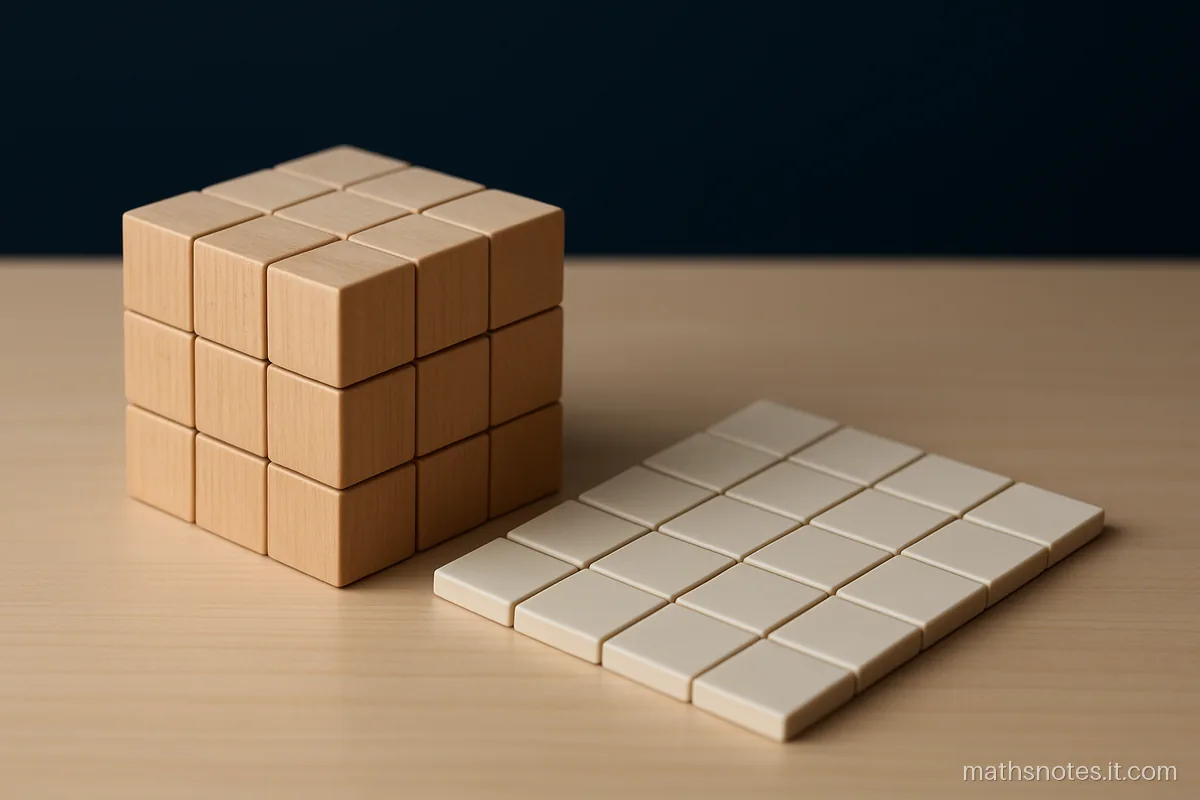
The chapter opens with square numbers as areas of squares made from unit tiles, then moves to cubes built from unit blocks. Along the way it asks you to notice patterns rather than learn rules by heart. The main topics are:
- square numbers and how to tell if a number is a perfect square
- patterns such as sums of odd numbers and the numbers between two squares
- square roots by repeated subtraction, by prime factors and by estimation
- cube numbers, perfect cubes and cube roots
- numbers that are both squares and cubes, and the famous taxicab number 1729
The new books do not carry numbered exercise sets in the old style. Questions sit inside the chapter as short Figure it Out blocks and at the end of each part. So when you search for chapter 1 solutions, what you really need is the method, which you can then apply to any question of this type.
Key words: square, square root, cube and cube root
Write these definitions in the front of your notebook.
- Square of n: the number n × n, written n2. The square of 12 is 144.
- Perfect square: a whole number that is the square of another whole number, such as 1, 4, 9, 16, 25.
- Square root: the number whose square is the original. √144 = 12 because 12 × 12 = 144.
- Cube of n: n × n × n, written n3. The cube of 6 is 216.
- Cube root: ∛216 = 6 because 6 × 6 × 6 = 216.
A square has two equal factors; a cube has three. That single sentence explains every rule in the chapter.
Patterns that help you test a number quickly
Before you factorise, use these checks to rule a number out in a few seconds.
- Last digit. A perfect square never ends in 2, 3, 7 or 8. So 2352 and 4567 cannot be squares, and you can say so at once.
- Zeros. A square ending in zeros has an even number of them: 100, 3600, 250000. A number like 4000 with three zeros is not a square.
- Odd numbers. 1 + 3 + 5 + 7 + 9 + 11 + 13 = 49 = 72. The sum of the first n odd numbers is always n2.
- Gaps. Between n2 and (n + 1)2 there are exactly 2n numbers that are not squares. Between 144 and 169 there are 24.
- Cube endings. Cubes can end in any digit, and the last digit of the cube fixes the last digit of its root: a cube ending in 8 has a root ending in 2, one ending in 7 has a root ending in 3.
Table of squares and cubes from 1 to 30
Learn at least the squares up to 25 and the cubes up to 12. They come up again in chapter 2, in the Baudhayana-Pythagoras theorem in Part II, and in mensuration.
| Number | Square | Cube |
|---|---|---|
| 1 | 1 | 1 |
| 2 | 4 | 8 |
| 3 | 9 | 27 |
| 4 | 16 | 64 |
| 5 | 25 | 125 |
| 6 | 36 | 216 |
| 7 | 49 | 343 |
| 8 | 64 | 512 |
| 9 | 81 | 729 |
| 10 | 100 | 1000 |
| 11 | 121 | 1331 |
| 12 | 144 | 1728 |
| 13 | 169 | 2197 |
| 14 | 196 | 2744 |
| 15 | 225 | 3375 |
| 16 | 256 | 4096 |
| 17 | 289 | 4913 |
| 18 | 324 | 5832 |
| 19 | 361 | 6859 |
| 20 | 400 | 8000 |
| 21 | 441 | 9261 |
| 22 | 484 | 10648 |
| 23 | 529 | 12167 |
| 24 | 576 | 13824 |
| 25 | 625 | 15625 |
| 26 | 676 | 17576 |
| 27 | 729 | 19683 |
| 28 | 784 | 21952 |
| 29 | 841 | 24389 |
| 30 | 900 | 27000 |
Read across each row: the middle column is the square and the last column is the cube.
Class 8 maths chapter 1 solutions: square root problems
Square root questions come in three shapes: find the root, test if a number is a square, and fix a number so that it becomes a square. Each needs only prime factors and pairing.
Example 1. Find √1764 by prime factorisation.
- 1764 = 2 × 2 × 3 × 3 × 7 × 7
- Pair the equal primes: (2 × 2) (3 × 3) (7 × 7)
- Take one from each pair: 2 × 3 × 7
- √1764 = 42
Check: 42 × 42 = 1764.
Example 2. Is 2352 a perfect square? If it is not, what least multiplier turns it into one?
- 2352 ends in 2, so it is not a perfect square.
- 2352 = 2 × 2 × 2 × 2 × 3 × 7 × 7 = 24 × 3 × 72
- The 3 has no partner.
- Multiply by 3: 2352 × 3 = 7056
- √7056 = 22 × 3 × 7 = 84
Smallest multiplier is 3, and the square root of the product is 84.
Example 3. By what least number should 1200 be divided so that the result is a perfect square?
- 1200 = 24 × 3 × 52
- The unpaired prime is 3.
- 1200 ÷ 3 = 400 = 202
Divide by 3. The square root of the result is 20.
Example 4. Estimate √50 to one decimal place.
- 72 = 49 and 82 = 64, so √50 lies between 7 and 8.
- 50 is very close to 49, so try 7.1.
- 7.1 × 7.1 = 50.41, which is just above 50.
- 7 × 7 = 49, just below, and 50 is nearer to 49 than to 50.41.
√50 is about 7.1 to one decimal place (it is 7.071 to three places).
Worked cube and cube root problems
For cubes, group equal primes in threes instead of pairs. A prime left over at the end means no whole number cube root exists.
Example 5. Find ∛3375.
- 3375 ends in 5, so divide by 5: 3375 = 5 × 675
- 675 = 5 × 135 = 5 × 5 × 27
- So 3375 = 5 × 5 × 5 × 3 × 3 × 3
- Group in threes: (5 × 5 × 5) (3 × 3 × 3)
- ∛3375 = 5 × 3 = 15
Example 6. What is the least number that 392 must be multiplied by to give a perfect cube?
- 392 = 2 × 2 × 2 × 7 × 7 = 23 × 72
- Three 2s make one complete triple. The 7s stop at two.
- Multiply by one more 7: 392 × 7 = 2744
- ∛2744 = 2 × 7 = 14
Answer: 7.
Example 7. 13824 is known to be a cube. Get ∛13824 from its last digit and its leading part.
- Last digit 4, so the cube root ends in 4 (since 43 = 64).
- Strike off the last three digits: 13 is left.
- 23 = 8 ≤ 13 < 27 = 33, which fixes 2 in the tens place.
- Guess 24 and check: 24 × 24 × 24 = 13824
∛13824 = 24. This shortcut works only when you already know the number is a perfect cube.
Example 8. Split 1729 into a pair of cubes, and then into a different pair.
- 13 + 123 = 1 + 1728 = 1729
- 93 + 103 = 729 + 1000 = 1729
Ramanujan noted that this is the smallest number with this property. It is often called the taxicab number.
Common mistakes in squares and cubes
- Pairing for a cube. Students find pairs when the question asks for a cube root. Count threes for cubes.
- Writing √(a + b) = √a + √b. √(9 + 16) is √25 = 5, not 3 + 4 = 7.
- Stopping factorisation early. 1200 = 12 × 100 is not prime factors. Keep going to 24 × 3 × 52.
- Confusing doubling with squaring. 62 is 36, not 12. 23 is 8, not 6.
- Forgetting the check. Multiply your root back. It takes ten seconds and catches most slips.
Exam focus for chapter 1
Class tests on this chapter almost always include one prime factor square root, one smallest multiplier or divisor question, one cube root and one pattern question such as the count of non-square numbers between two squares. Show the factor tree or the division ladder, then the pairs or triples, then the answer. Teachers give marks for the grouping step even when the final multiplication goes wrong.
A number can be both a square and a cube: 64 = 82 = 43, and 4096 = 642 = 163. Such numbers are sixth powers. Questions on them are a favourite for the last mark of a test.
For more drill on roots, use our squares and square roots class 8 notes and the cube roots 1 to 30 table.
Studying from the old Mathematics book?
In the older rationalised Mathematics book, chapter 1 was Rational Numbers, while squares and square roots were chapter 5 and cubes and cube roots were chapter 6. If your school still uses that book, the methods on this page still apply to those two chapters. Look at the list of chapters printed at the front of your copy to see which edition it is.
Ganita Prakash Part II also restarts its numbering at chapter 1. There, chapter 1 is Fractions in Disguise, a separate topic. All class 8 chapters we cover are listed on the class 8 maths hub, and the next chapter in Part I, Power Play, is on our class 8 maths chapter 2 page.
Practice questions with answers
Solve on paper, then compare with the hidden working.
Practice 1.1, question 1. Find √2025 by prime factors.
Show answer
2025 = 34 × 52. Taking one of each pair gives 3 × 3 × 5 = 45. So √2025 = 45.
Practice 1.1, question 2. How many non-square numbers lie between 152 and 162?
Show answer
2n with n = 15 gives 30 numbers (226 to 255).
Practice 1.1, question 3. Without adding term by term, find 1 + 3 + 5 + ... + 23.
Show answer
These are the first 12 odd numbers, since 23 = 2 × 12 - 1. The sum is 122 = 144.
Practice 1.2, question 1. Find ∛10648.
Show answer
10648 = 23 × 113, so the cube root is 2 × 11 = 22.
Practice 1.2, question 2. Divide 675 by the least number that leaves a perfect cube. What is that number?
Show answer
675 = 33 × 52. The two 5s cannot form a triple, so divide by 25. 675 ÷ 25 = 27 = 33.
Practice 1.2, question 3. Is 625 a perfect cube? Is it a perfect square?
Show answer
625 = 54. Four 5s make two pairs, so 625 = 252 is a square. Four 5s do not split into groups of three, so it is not a cube.
Frequently asked questions
What is class 8 maths chapter 1 in the new book?
In Ganita Prakash Part I, chapter 1 is A Square and A Cube. It covers square numbers, square roots, cube numbers and cube roots, mostly through patterns and prime factorisation.
Where can I find class 8 maths chapter 1 solutions?
This page solves eight problems of every type the chapter uses and gives six practice questions with answers. They are our own questions, so use them to learn the method and then apply it to the book's Figure it Out questions.
How do I know if a number is a perfect square?
First check the last digit: squares never end in 2, 3, 7 or 8. Then write the prime factors. If every prime appears an even number of times, the number is a perfect square.
What is the difference between a square root and a cube root?
A square root is used twice as a factor to make the original number, and a cube root is used three times. √64 = 8 because 8 × 8 = 64, while ∛64 = 4 because 4 × 4 × 4 = 64.
Why is 1729 special?
No whole number below 1729 splits into two cubes in more than one way, yet 1729 does it twice: 1 + 1728 and also 729 + 1000. Ramanujan pointed this out, and the chapter uses it as a number pattern to explore.
Is there a class 8 maths chapter 1 PDF?
We do not host the textbook. To keep these notes offline, press the Save as PDF button near the top and read them without a connection.