
The cube root of a number is the value that gives that number when you multiply it by itself three times, so the cube root of 125 is 5 because 5 × 5 × 5 = 125. We write it with the sign ∛, as in ∛125 = 5. Finding a cube root undoes cubing, in the same way that subtraction undoes addition.
This page explains the idea first, then two hand methods for perfect cubes: prime factors, and a quick unit digit trick for big numbers. After that come negatives, fractions and decimals, a side by side look at square root and cube root, and the errors that show up most in answer sheets.
At a glance
Sign
∛∛8
2∛125
5∛1728
12∛(-27)
-3As a power
n1/3
What is a cube root
Cubing a number means using it three times in a product: 43 = 4 × 4 × 4 = 64. The cube root goes the other way. It asks: which number, cubed, gives 64? The answer is 4, so ∛64 = 4.
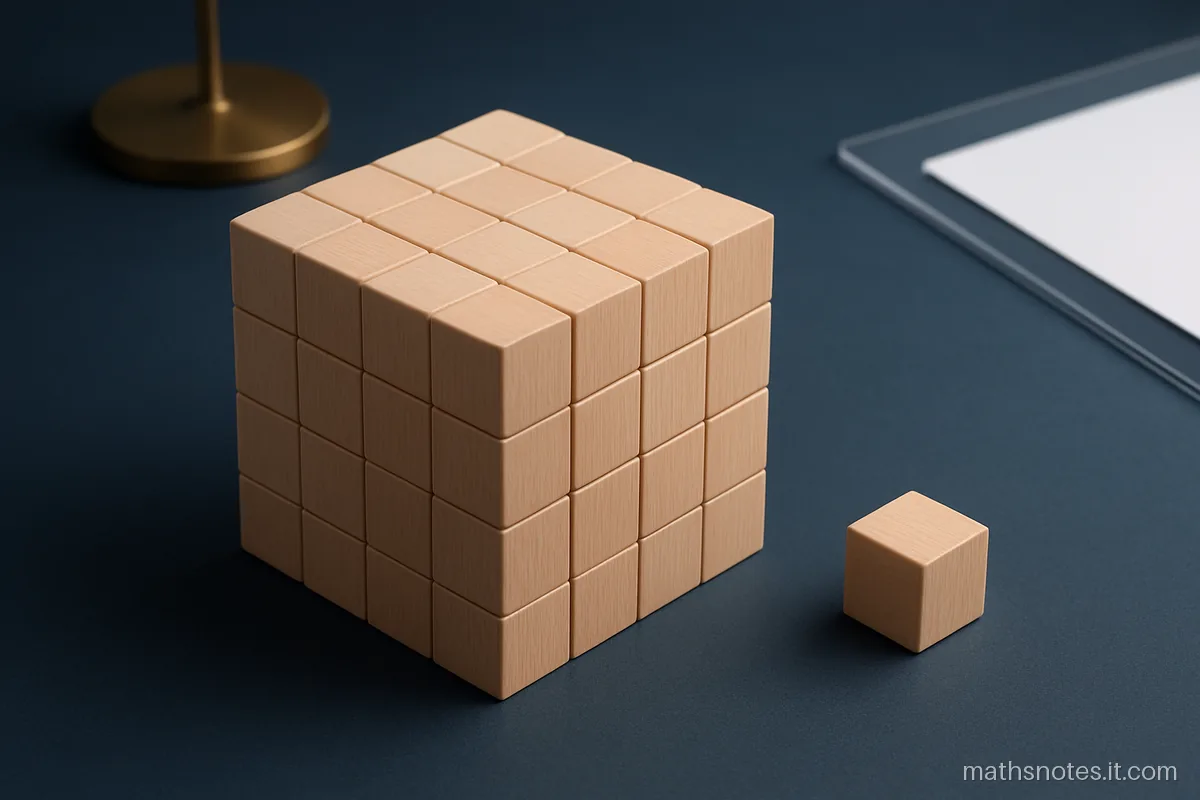
Think of a solid cube built from small blocks. If 64 blocks make the whole cube, each edge is 4 blocks long. One edge of the block is ∛ of the block count. That picture is why the word cube is used.
Numbers such as 1, 8, 27, 64 and 125 are called perfect cubes because their cube roots are whole numbers. Most numbers are not perfect cubes, and their cube roots are long decimals.
Perfect cubes to learn first
Knowing the cubes of 1 to 20 makes every cube root question faster. Learn at least 1 to 10 by heart; the rest you can rebuild when needed.
| Number | Cube |
|---|---|
| 1 | 1 |
| 2 | 8 |
| 3 | 27 |
| 4 | 64 |
| 5 | 125 |
| 6 | 216 |
| 7 | 343 |
| 8 | 512 |
| 9 | 729 |
| 10 | 1000 |
| 11 | 1331 |
| 12 | 1728 |
| 13 | 2197 |
| 14 | 2744 |
| 15 | 3375 |
| 16 | 4096 |
| 17 | 4913 |
| 18 | 5832 |
| 19 | 6859 |
| 20 | 8000 |
For the decimal cube roots of 2, 3, 4 and the other numbers that are not perfect cubes, use our cube root 1 to 30 table.
Method 1: cube root by prime factorisation
- Break the number into prime factors.
- Group equal factors in sets of three.
- Take one factor from each group.
- Multiply those factors. That product is the cube root.
Example 1. Find ∛1728.
- 1728 = 2 × 2 × 2 × 2 × 2 × 2 × 3 × 3 × 3.
- Groups of three: (2 × 2 × 2) (2 × 2 × 2) (3 × 3 × 3).
- One from each group: 2, 2 and 3.
- ∛1728 = 2 × 2 × 3 = 12.
Check: 12 × 12 × 12 = 1728.
Example 2. Find ∛3375.
- 3375 = 3 × 3 × 3 × 5 × 5 × 5.
- Groups: (3 × 3 × 3) (5 × 5 × 5).
- ∛3375 = 3 × 5 = 15.
A prime left without its group of three tells you at once that the number cannot be a perfect cube. Many test questions rest on exactly that check.
Is it a perfect cube? Finding the smallest multiplier
A frequent question asks for the smallest number to multiply or divide by so the result becomes a perfect cube. Group the prime factors and look at what is missing.
Example 3. Check whether 500 is a perfect cube, and name the least whole number that should multiply it to give one.
- 500 = 2 × 2 × 5 × 5 × 5.
- Three 5s sit together, but the 2s come only as a pair.
- So 500 is not a perfect cube.
- One more 2 completes the group: 500 × 2 = 1000 = 103.
Dividing instead: 500 ÷ 4 = 125 = 53, so 4 is the smallest divisor that works.
Method 2: the unit digit trick for large perfect cubes
When you already know a number is a perfect cube, you can read its cube root without factorising. Each last digit 0 to 9 gives a cube with its own last digit:
| Number ends in | 0 | 1 | 2 | 3 | 4 | 5 | 6 | 7 | 8 | 9 |
|---|---|---|---|---|---|---|---|---|---|---|
| Cube ends in | 0 | 1 | 8 | 7 | 4 | 5 | 6 | 3 | 2 | 9 |
Only 2, 3, 7 and 8 swap: 2 and 8 trade places, and so do 3 and 7. The other digits keep their own last digit.
Example 4. You are told 17576 is a perfect cube. Find ∛17576.
- Split off the last three digits: 17 | 576.
- 576 ends in 6, so the root ends in 6.
- Look at the front group 17: 23 = 8 ≤ 17 < 27 = 33, which puts 2 in the tens place.
- ∛17576 = 26.
Example 5. Find ∛13824.
- Groups: 13 | 824. The last digit 4 gives a unit digit of 4.
- 8 ≤ 13 < 27, so the root starts with 2.
- ∛13824 = 24.
This trick only works for perfect cubes up to six digits. For anything else, use prime factors or estimate.
Cube roots of negative numbers, fractions and decimals
A negative number times itself three times stays negative: (-3) × (-3) × (-3) = -27. So negative numbers have real cube roots, unlike square roots.
For a fraction, take the cube root of the top and the bottom separately. ∛(8/125) = ∛8 / ∛125 = 2/5.
For a decimal, count decimal places. A cube has three times as many decimal places as its root. 0.027 has three places, so its root has one: ∛0.027 = 0.3. In the same way, ∛1.728 = 1.2, because 12 cubed is 1728.
Square root and cube root side by side
Students often confuse these two. The table sets them next to each other so the differences are clear.
| Point | Square root | Cube root |
|---|---|---|
| Sign | √ | ∛ |
| Question it answers | What times itself gives n? | What times itself, three times, gives n? |
| Of 64 | 8 | 4 |
| Of a negative number | No real answer | A negative answer, ∛(-27) = -3 |
| Prime factor rule | Pair equal factors | Group equal factors in threes |
| As a power | n1/2 | n1/3 |
For a full treatment of the square root side, read our square root notes and the page on how to find square root values by hand.
Mistakes that lose marks
- Taking pairs instead of triples while grouping factors. Pairs give the square root.
- Writing ∛27 = 9. Nine is 27 ÷ 3, not a cube root.
- Saying ∛(-64) has no answer. It is -4.
- Using the unit digit trick on a number that is not a perfect cube. ∛50 is about 3.684, and no digit rule will give that.
- Forgetting to check. Cube your answer on the side of the page; it takes ten seconds.
Frequently asked questions
What is the cube root of 64?
It is 4, because 4 × 4 × 4 = 64. Compare this with the square root of 64, which is 8.
What is the difference between square root and cube root?
A square root is the number that gives n when used twice in a product, and a cube root is the one that gives n when used three times. So √64 = 8 but ∛64 = 4. Negative numbers have cube roots but no real square roots.
Can a cube root be negative?
Yes. Because (-2) × (-2) × (-2) = -8, the cube root of -8 is -2. The cube root of a negative number is always negative.
How do you know if a number is a perfect cube?
Split it into primes, then group equal primes in threes. If every prime fits into complete groups of three, it is a perfect cube; if any is left over, it is not.
What is the cube root of 1000?
It is 10, because 10 × 10 × 10 = 1000. A one followed by three zeros has a root of one followed by one zero.
What is the cube root of 2?
∛2 is about 1.260 to three decimal places. It is not a whole number because 2 is not a perfect cube.