
This maths worksheet for class 2 gives your child 32 practice questions on place value up to 200, adding and subtracting with carrying, multiplication as equal groups, sharing, money, clock time, length and shapes. The answers sit in a separate key at the bottom, each part hidden behind a toggle.
The sheet prints neatly on A4 paper in black and white. Use the print option in your browser, or the save button near the page title to keep a copy for later, and hand your child one part at a time.
At a glance
Questions
32Numbers
Up to 200Sums
2 digit, with carryingTables used
2, 3, 5 and 10Time per part
About 15 minutesAnswers
Separate key
Before you start: a note for parents
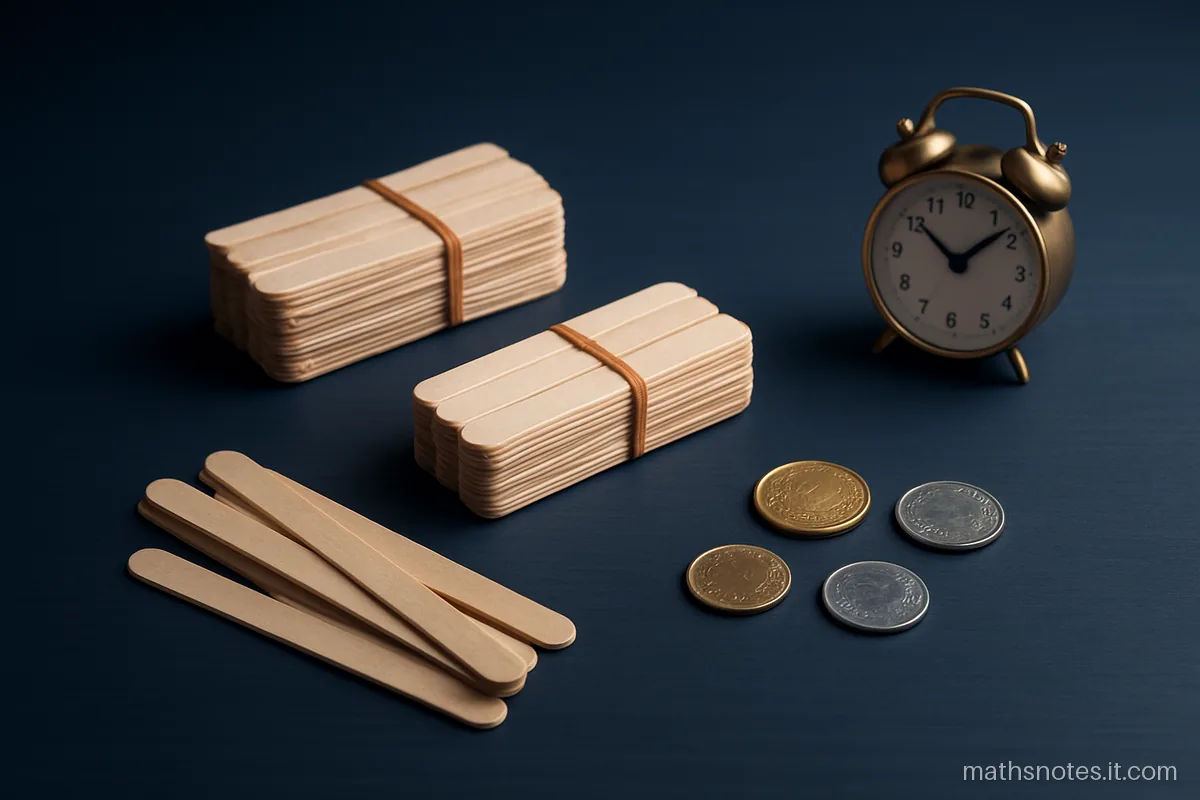
At seven or eight years old, children are moving from counting objects to working with tens and ones in their heads. Mistakes in this year usually come from place value: writing 7 tens and 4 ones as 47, or lining up 125 + 40 so that the 4 sits under the 1. When you see an error like that, ask your child to build the number with bundles of ten sticks and loose sticks. Once they see it, they rarely repeat the mistake.
If your child finds this sheet too hard, spend a week on the class 1 maths worksheets first. If it is easy, move up to the class 3 maths worksheets.
What this maths worksheet for class 2 covers
This class 2 maths worksheet has 32 questions in four parts that follow the order most schools teach in the second year: numbers and place value up to 200, adding and subtracting two digit numbers with carrying, early multiplication as equal groups and sharing, and everyday maths with money, clock time, length and shapes. Every question is original, and the answer key is kept apart so the worksheet for class 2 maths can be used as a short test.
Whether your child studies under CBSE, ICSE or a state board, these skills are the core of the 2nd class maths worksheet topics, so the sheet fits any syllabus.
Part A: numbers up to 200
Children in class 2 read, write and compare numbers well past 100. Ask your child to say each answer aloud before writing it.
Numbers and place value
- Write the number for 7 tens and 4 ones.
- Fill in the gaps: 96, 97, 98, ___, ___, 101
- Count in fives: 35, 40, 45, ___, ___
- Write 86 in words.
- What is the place value of 3 in 138?
- Write the smallest and the largest 2 digit numbers.
- Is 47 odd or even?
- Arrange in order from biggest to smallest: 64, 46, 99, 19
Part B: adding and subtracting 2 digit numbers
Write each sum in columns, tens under tens and ones under ones. Questions 2, 3, 6 and 7 need carrying or borrowing, so watch those closely.
Add or subtract
- 34 + 25 = ___
- 47 + 18 = ___
- 56 + 39 = ___
- 125 + 40 = ___
- 68 - 23 = ___
- 52 - 17 = ___
- 80 - 36 = ___
- 150 - 30 = ___
Part C: first steps in multiplying and sharing
Multiplication here means equal groups. Let your child draw dots in groups, or use spoons and beads, before using the table.
Groups, tables and sharing
- 4 groups of 3 apples. Write it as an addition and as a multiplication. How many apples?
- 5 × 2 = ___
- 3 × 5 = ___
- 10 × 6 = ___
- Share 12 laddoos equally among 3 friends. How many does each friend get?
- How many wheels do 6 bicycles have?
Part D: money, time, length and shapes
Real coins, a wall clock and a ruler make this part easier. Read the longer questions aloud if your child is still building reading speed.
Everyday maths and word problems
- Meena has a 20 rupee note and a 10 rupee note. How much money does she have?
- A toy costs 45 rupees. You pay with a 50 rupee note. How much do you get back?
- The short hand of a clock is on 3 and the long hand is on 12. What time is it?
- The long hand is on 6 and the short hand is just past 8. What time is it?
- How many days are there in a week?
- A ribbon is 15 cm long. Another is 9 cm long. How much longer is the first ribbon?
- How many sides does a rectangle have?
- Continue the pattern: 5, 10, 15, 20, ___
- A class has 18 girls and 15 boys. How many children are there in all?
- Rohan had 40 stickers. He gave 14 to his sister. How many does he have left?
Answer key for the class 2 maths worksheet
Open each part only after your child has finished it. For a wrong answer, point to the question and let your child try once more before you explain.
Part A: numbers up to 200
Show answer
- 74
- 99 and 100
- 50 and 55
- Eighty six
- 30 (3 tens)
- 10 and 99
- Odd
- 99, 64, 46, 19
Part B: adding and subtracting 2 digit numbers
Show answer
- 59
- 65
- 95
- 165
- 45
- 35
- 44
- 120
Part C: first steps in multiplying and sharing
Show answer
- 3 + 3 + 3 + 3 = 12, and 4 × 3 = 12 apples
- 10
- 15
- 60
- 4 laddoos each
- 6 × 2 = 12 wheels
Part D: money, time, length and shapes
Show answer
- 30 rupees
- 5 rupees
- 3 o'clock
- Half past 8
- 7
- 6 cm
- 4
- 25
- 33 children
- 26 stickers
Making the most of class 2 maths worksheets
Short, regular practice beats one long sitting. Two parts a week, with the wrong answers redone the next day, builds both speed and confidence. Keep the finished sheets in a folder; after a month, give the same sheet again and compare the time taken.
Topics behind each part are explained for parents on class 1 and 2 maths. For quick spoken drills on the way to school, try mental maths worksheets, and for more sheets across classes visit the maths worksheets hub.
Frequently asked questions
What maths does a class 2 child learn?
Most class 2 children work with numbers into the low hundreds, tens and ones, adding and subtracting two digit numbers with carrying, and early multiplication as equal groups. Money, reading the clock to the hour and half hour, length in centimetres and simple shapes are also part of the year.
Does this class 2 maths worksheet have answers?
Yes. Scroll to the end: every part has its own answers, folded behind a Show answer toggle.
How can I help my child with carrying in addition?
Use bundles of ten sticks and loose sticks. When the ones add up to 10 or more, tie ten loose sticks into a bundle and move it to the tens. Doing this with real objects makes the written carry make sense.
Which multiplication tables should a class 2 child know?
Most children start with the tables of 2, 5 and 10, then 3 and 4. At this stage it matters more that they understand multiplication as equal groups than that they recite tables quickly.
Can I use this maths worksheet for class 2 for revision before exams?
Yes. Give one part a day in the week before the test and redo any question that went wrong. The mix of number, operation and everyday questions matches what most class 2 tests check.