
Vedic maths is a collection of 16 short rules, called sutras, and 13 sub sutras for doing arithmetic quickly in your head, put together by Swami Bharati Krishna Tirtha in the twentieth century. It turns sums like 97 × 96 or 652 into a few seconds of mental work.
Below are the five tricks most worth learning, each with worked examples and a line of algebra showing why it works. Knowing why matters: it tells you when a trick applies and when it does not. There is also a section on how Vedic maths differs from abacus maths, which parents often confuse.
At a glance
Sutras
16 sutras, 13 sub sutrasCompiled by
Bharati Krishna TirthaSquares ending in 5
652 = 4225Near a base
97 × 96 = 9312Times 11
72 × 11 = 792Best for
Mental arithmetic
What is Vedic maths
Bharati Krishna Tirtha, a scholar and later Shankaracharya of Puri, said he found these rules in the Vedas. Historians point out that the sutras do not appear in any known Vedic text, so the methods are best seen as his own clever system with Sanskrit names. That does not make them less useful. Each trick is ordinary algebra arranged so that the hard part becomes easy.
The sutras have names such as Ekadhikena Purvena ("by one more than the previous one"), Nikhilam ("all from 9 and the last from 10") and Urdhva Tiryagbhyam ("vertically and crosswise"). You do not need the Sanskrit to use them, but the names help you remember which trick is which.
Vedic maths tricks: squaring a number that ends in 5
This uses Ekadhikena Purvena. Take the digits before the 5, multiply by one more than themselves, and then place 25 on the right.
Example 1. Find 652.
- The digit before 5 is 6. One more is 7.
- 6 × 7 = 42.
- Write 25 after it: 4225.
Example 2. Find 1052.
- The part before 5 is 10. One more is 11.
- 10 × 11 = 110, then write 25: 11025.
Why it works: (10a + 5)2 = 100a2 + 100a + 25 = 100a(a + 1) + 25.
Nikhilam: multiplying numbers near 100
When both numbers are close to a base like 100, work with how far each is from the base.
Example 3. Find 97 × 96.
- 97 is 3 below 100 and 96 is 4 below.
- Cross subtract: 97 - 4 = 93 (or 96 - 3, the same).
- Multiply the gaps: 3 × 4 = 12, written as two digits.
- Answer: 9312.
Example 4. Find 104 × 107.
- Both are above 100, by 4 and 7.
- 104 + 7 = 111, and 4 × 7 = 28.
- Answer: 11128.
Example 5. Find 98 × 89.
- Gaps are 2 and 11. Cross subtract: 98 - 11 = 87.
- 2 × 11 = 22. Answer: 8722.
Why it works: (100 - a)(100 - b) = 100(100 - a - b) + ab. The trick fails when ab has more than two digits; then you carry the extra digit left.
Vertically and crosswise for any two digit numbers
Urdhva Tiryagbhyam multiplies any two digit numbers in three steps: left digits, cross products added, right digits.
Example 6. Find 23 × 41.
- Vertically on the left: 2 × 4 = 8.
- Crosswise: 2 × 1 + 3 × 4 = 2 + 12 = 14.
- Vertically on the right: 3 × 1 = 3.
- Combine 8 | 14 | 3: carry the 1 of 14 left, giving 9 | 4 | 3 = 943.
Example 7. Find 32 × 27.
- 3 × 2 = 6; 3 × 7 + 2 × 2 = 25; 2 × 7 = 14.
- 6 | 25 | 14: carry 1 from 14, giving 6 | 26 | 4; carry 2 from 26, giving 8 | 6 | 4.
- Answer: 864.
This is just the usual long multiplication with the carries done at the end, which is why it always works.
Subtracting from 1000 and multiplying by 11
All from 9 and the last from 10. To subtract from 1000 or 10000, take each digit from 9 and the last one from 10.
Example 8. 1000 - 357: 9 - 3 = 6, 9 - 5 = 4, 10 - 7 = 3, so 643. And 10000 - 2468 = 7532.
Times 11: write the two digits apart and put their sum between them, carrying if needed.
Example 9. 72 × 11: 7 | 7 + 2 | 2 = 792. 87 × 11: 8 | 15 | 7, carry 1, giving 957.
Same first digit, last digits add to 10: 46 × 44. Multiply 4 by one more, 4 × 5 = 20, then 6 × 4 = 24, giving 2024. More shortcuts like this are on our maths tricks page.
Vedic maths and abacus maths: the difference
| Point | Vedic maths | Abacus maths |
|---|---|---|
| What it is | Mental rules written as sutras | Calculation on a frame of beads |
| Tool | Pencil or none | Abacus, later imagined in the mind |
| Best age | About class 4 and above | Often started around age 5 to 7 |
| Strength | Multiplication, squares, special cases | Fast addition and subtraction of long numbers |
| Needs | Times tables up to 10 | Regular practice on the frame |
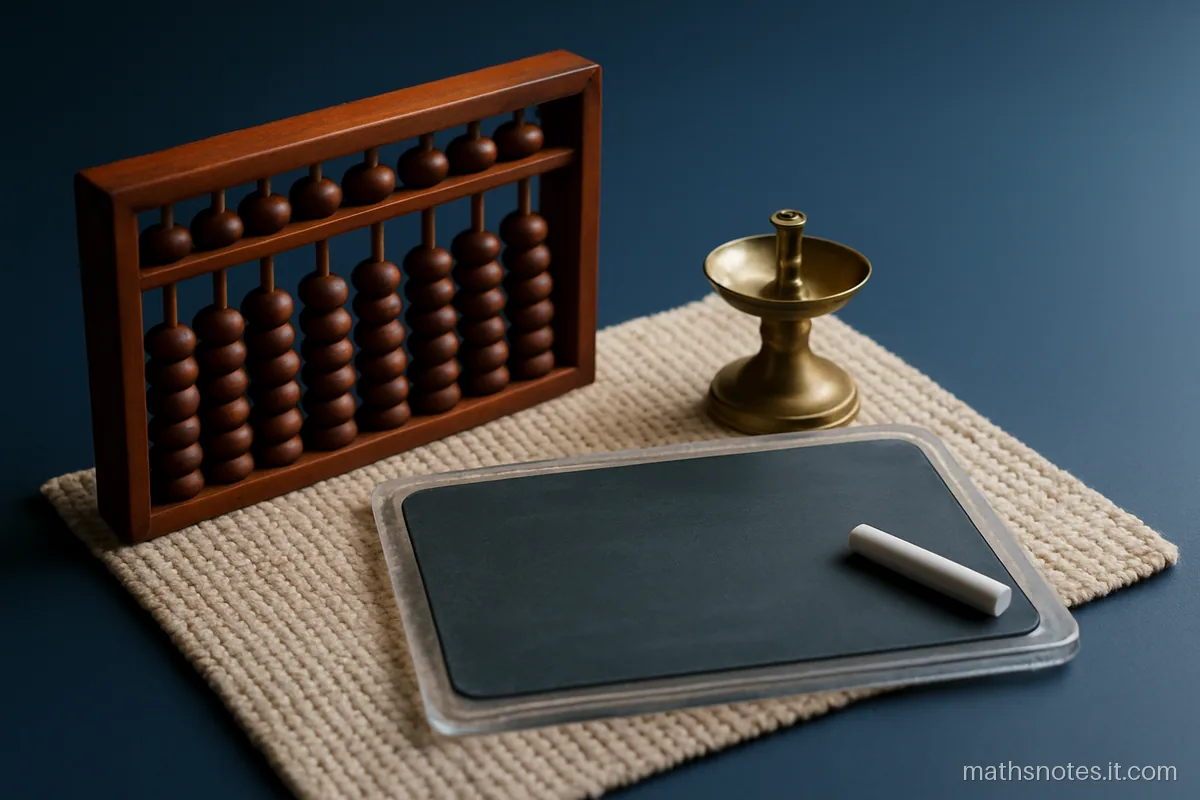
On a common abacus, each rod has one upper bead worth 5 and four lower beads worth 1 each. Children learn to see the beads in their head and add long columns very fast. Neither method replaces understanding place value, which our place value page explains.
Vedic maths for kids: where to start
Begin with times 11 and squares ending in 5. Both need only one multiplication fact and give a surprising answer, which keeps children interested. Move on to Nikhilam only when tables up to 10 are solid. Practise three sums a day rather than thirty once a week. A short self made Vedic maths course of four weeks, one trick a week, is plenty for a class 5 child. Pair it with our mental maths drills.
Should you use Vedic maths in exams
Use it to calculate, but write normal working in board exam answers. Examiners mark the method shown, and a line like "97 × 96 = 9312" with nothing else is fine for arithmetic but not for an algebra step. In competitive exams with no marks for working, these tricks save real time. Always check one answer in a second way, for instance by rough estimation: 97 × 96 must be a little under 100 × 100 = 10000. For more fun with numbers, visit the maths puzzles hub.
Frequently asked questions
What is Vedic maths?
Vedic maths is a set of 16 sutras and 13 sub sutras for quick mental arithmetic, compiled by Bharati Krishna Tirtha. Each rule is a shortcut based on ordinary algebra.
Is Vedic maths really from the Vedas?
Its author said so, but historians have not found these sutras in known Vedic texts. It is best treated as a modern system with Sanskrit names.
Is abacus better than Vedic maths?
They suit different needs. Abacus builds very fast addition and subtraction in young children, while Vedic maths gives shortcuts for multiplication and squares to older students.
What is the easiest Vedic maths trick?
The easiest is times 11 for two digit numbers. Put the sum of the digits between them, so 53 × 11 = 583.
At what age can kids learn Vedic maths?
Most children can start around class 4, once they know their tables up to 10. Begin with times 11 and squares ending in 5.
Does Vedic maths help in competitive exams?
Yes, for arithmetic heavy sections where only the answer counts. In school exams, still write the standard working.