
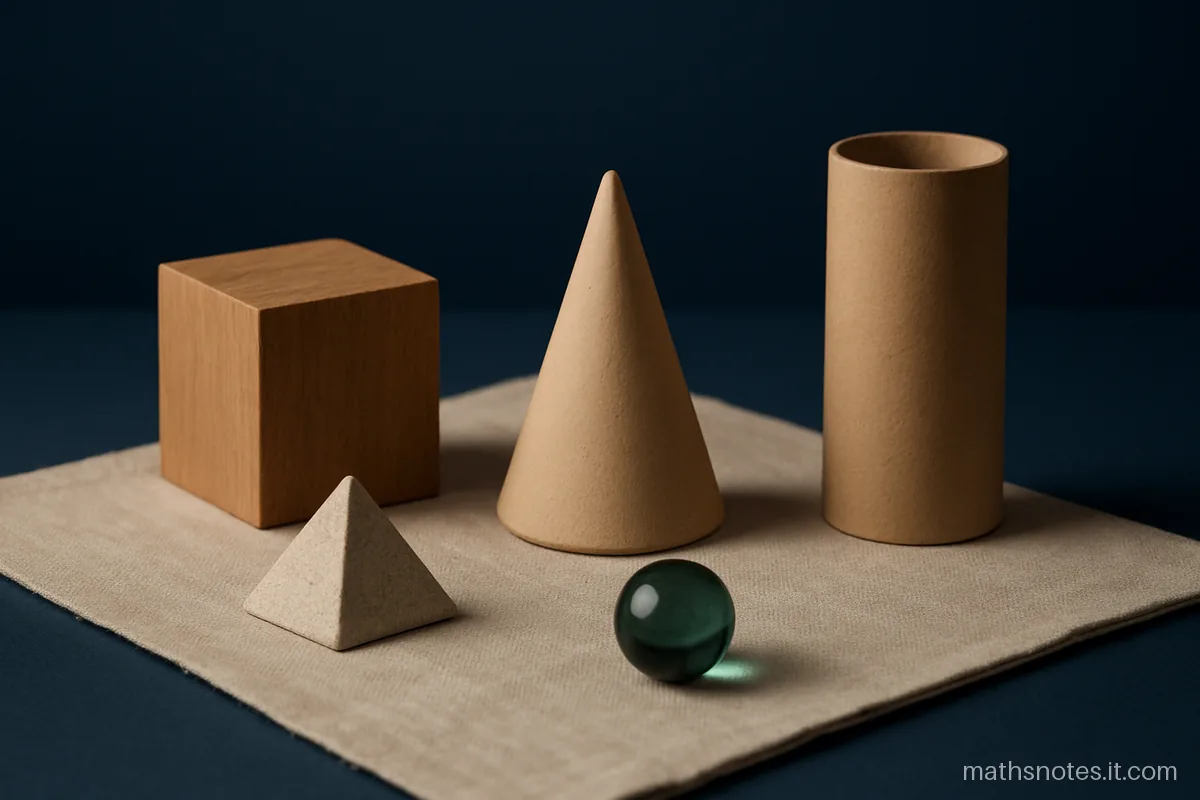
3D shapes in maths are solid figures with three dimensions, length, breadth and height, so they take up space and have volume. A cube, a cylinder, a cone and a sphere are the four you meet first; a dice is a cube, a pipe is a cylinder and a ball is a sphere.
This page names the common solid shapes, counts their faces, edges and vertices, checks them with Euler's rule, and gives the surface area and volume formulas with solved examples. Flat figures are on shapes in maths.
At a glance
Dimensions
Length, breadth, heightCube
6 faces, 12 edges, 8 verticesEuler's rule
F + V - E = 2Cube volume
a3Sphere volume
(4/3)πr3Cone volume
(1/3)πr2h
Solid shapes in maths: faces, edges and vertices
A face is a flat or curved surface of a solid. An edge is a line where two faces meet. A vertex is a corner where edges meet. Solids with only flat faces, all of them polygons, are called polyhedra: cubes, prisms and pyramids. Solids with a curved surface, such as cylinders, cones and spheres, are not polyhedra.
Faces, edges and vertices of common solids
| Solid | Faces (F) | Edges (E) | Vertices (V) | F + V - E |
|---|---|---|---|---|
| Cube | 6 | 12 | 8 | 6 + 8 - 12 = 2 |
| Cuboid | 6 | 12 | 8 | 6 + 8 - 12 = 2 |
| Triangular prism | 5 | 9 | 6 | 5 + 6 - 9 = 2 |
| Square pyramid | 5 | 8 | 5 | 5 + 5 - 8 = 2 |
| Triangular pyramid (tetrahedron) | 4 | 6 | 4 | 4 + 4 - 6 = 2 |
| Pentagonal prism | 7 | 15 | 10 | 7 + 10 - 15 = 2 |
| Hexagonal pyramid | 7 | 12 | 7 | 7 + 7 - 12 = 2 |
For every polyhedron without holes, F + V - E = 2. This is Euler's rule, after Leonhard Euler. It is a handy test of a count: if a solid has 7 faces and 10 vertices, it must have 15 edges. A cylinder has 3 surfaces (2 flat, 1 curved) and 2 curved edges, a cone has 2 surfaces and 1 vertex, while a sphere is one smooth surface with neither edges nor corners; Euler's rule is only for polyhedra.
Cube definition in maths and the cube formula
Cube definition in maths: a cube is a solid with six square faces, all equal, where three faces meet at each corner at right angles. All 12 edges have the same length, a. A dice, an ice cube and a sugar cube are everyday examples.
These three make up the cube formula maths students use most, along with the total edge length 12a. A cube is a special cuboid in which length, breadth and height are equal, so every cuboid formula turns into a cube formula when you put l = b = h = a.
Example 1. A cube has edge 4 cm. Find its surface area, volume, total edge length and diagonal.
- Surface area = 6 × 42 = 96 cm2
- Volume = 43 = 64 cm3
- Total edge length = 12 × 4 = 48 cm
- Diagonal = 4√3, roughly 6.93 cm when rounded to two decimals
Example 2. A cube holds 343 cm3. Find its edge and its surface area.
- a3 = 343, so a = ∛343 = 7 cm
- Surface area = 6 × 49 = 294 cm2
3D shapes in maths with examples from daily life
| Solid | What defines it | Everyday example |
|---|---|---|
| Cuboid | Six rectangular faces, opposite faces equal | A brick, a lunch box |
| Cylinder | Two equal parallel circles joined by a curved surface | A water pipe, a tin can |
| Cone | A circular base narrowing to one vertex | An ice cream cone, a birthday cap |
| Sphere | Every surface point the same distance from the centre | A football, a marble |
| Hemisphere | Half a sphere, with one flat circular face | A bowl |
| Prism | Two equal parallel polygon ends joined by rectangles | A tent, a glass prism |
| Pyramid | A polygon base with triangles meeting at a point | A roof tip, a paperweight |
A prism is named by its end face (triangular prism, hexagonal prism) and a pyramid by its base (square pyramid). Learning the definition column is what earns marks in naming questions.
Surface area and volume of curved solids
Example 3. A cylinder has radius 5 cm and height 7 cm. What are its curved surface and its volume? Use π = 22/7.
- Curved surface = 2 × 22/7 × 5 × 7 = 220 cm2
- Volume = 22/7 × 25 × 7 = 550 cm3
Example 4. A cone stands 8 cm high on a base of radius 6 cm. Using π = 3.14, give its slant height, curved surface and volume.
- l = √(36 + 64) = √100 = 10 cm
- Curved surface = 3.14 × 6 × 10 = 188.4 cm2
- Volume = (1/3) × 3.14 × 36 × 8 = 301.44 cm3
Example 5. A marble-like ball has a 3 cm radius. What are its outer area and its volume? Use π = 3.14.
- Surface = 4 × 3.14 × 9 = 113.04 cm2
- Volume = (4/3) × 3.14 × 27 = 113.04 cm3
At r = 3 both answers read 113.04, yet one is in square centimetres and the other in cubic centimetres.
Nets: unfolding a solid
A net is the flat pattern left after slicing a solid along chosen edges and pressing it flat. A cube has 11 different nets, each made of six squares. A cylinder opens into two circles and a rectangle whose length is the circumference 2πr; that is why its curved surface is 2πr × h. A cone opens into a circle and a sector. Folding paper nets is the quickest way to see why the surface area formulas work, and it makes a good classroom model; see maths working model for ideas.
Common mistakes with solid shapes
- Counting a cylinder as having vertices. It has none.
- Using the vertical height h instead of the slant height l in the cone surface formula.
- Forgetting the (1/3) in the cone volume; without it you get the volume of the cylinder that would enclose the cone.
- Naming every box a cube. Only when all twelve edges match is it one.
For full chapter practice with surface areas and volumes, see mensuration class 8, surface areas and volumes class 9 and the mensuration hub.
Frequently asked questions
What are 3D shapes in maths?
They are solid shapes with length, breadth and height. Cubes, cuboids, cylinders, cones, spheres, prisms and pyramids are the usual school examples.
What is the cube definition in maths?
A cube is a solid with six equal square faces, 12 equal edges and 8 vertices. Its volume is a3 and its surface area is 6a2, where a is the edge.
How many faces, edges and vertices does a square pyramid have?
It has 5 faces (one square, four triangles), 8 edges and 5 vertices. Check: 5 + 5 - 8 = 2.
Is a sphere a polyhedron?
No. A polyhedron has only flat polygon faces, while a sphere's single surface curves all the way round, leaving no edge or corner anywhere.
What is the difference between 2D and 3D shapes?
A 2D shape is flat and has area but no volume, like a square. A 3D shape is solid and has both surface area and volume, like a cube.